Kakobuy Rain Commute Shoe Grip Checks
What to Check First for Rainy Commute Shoes
The core task of rainy commute shoes is not to "look waterproof", but to minimize the risk of slipping, uneven sole wear, and wet feet between wet subway entrances, tiled corridors, crosswalks, office building lobbies, and bus stops. When buying shoes on Chinese e-commerce platforms through kakobuy, buyers usually cannot try them on before ordering, so it is more appropriate to break the judgment into items that can be checked, supplemented with photos, and decided on: whether the outsole rubber covers key stress areas, whether the tread can drain water, whether the forefoot and heel are prone to being worn smooth, whether the upper can handle light rain, and whether the QC photos are sufficient to confirm these points. ☔
This article applies to people who want to buy daily commute shoes, light outdoor style shoes, casual sports shoes, or low-top shoes. It does not apply to icy roads, non-slip work shoes, hiking routes, motorcycle riding, or professional safety scenarios, because these scenarios require clear certification, actual test data, or specialized sole materials, and cannot be judged solely by product images and warehouse inspections.
The information in this article was verified on 2026-09-09. The kakobuy-related processes are based on currently available platform information: the platform provides Chinese product purchasing, freight forwarding, warehouse quality inspection, and international shipping services; inspection mainly checks style, quantity, color, size, model, and other appearance information, and is not equivalent to wet grip testing.
Evidence Boundary: No Actual Grip Testing Promises
Wet grip is a highly variable fact, affected by outsole material, tread depth, ground surface, sole wear, gait, body weight, standing water, oil stains, and temperature. Looking only at product detail pages and kakobuy warehouse QC photos can at most do a "risk screening", and cannot guarantee that a pair of shoes is safe on all wet and slippery surfaces.
Therefore, when judging, avoid three types of misconceptions:
- Do not automatically interpret "waterproof", "outdoor", "thick sole", or "trendy shoes" as non-slip.
- Do not treat seller promotional images as actual grip test data.
- Do not ignore the tread in the forefoot flex zone and heel landing area just because the sole is thick.
A safer approach is to first use product images to filter out candidates that are clearly unsuitable for rainy commutes, and then use kakobuy warehouse QC photos to confirm the actual outsole, upper, and key angles. If the QC photos cannot show the sole, you should decide whether to request additional details within the return/exchange window, to avoid discovering problems only after consolidation or shipping.
How to Observe Outsole Rubber Coverage and Tread Direction
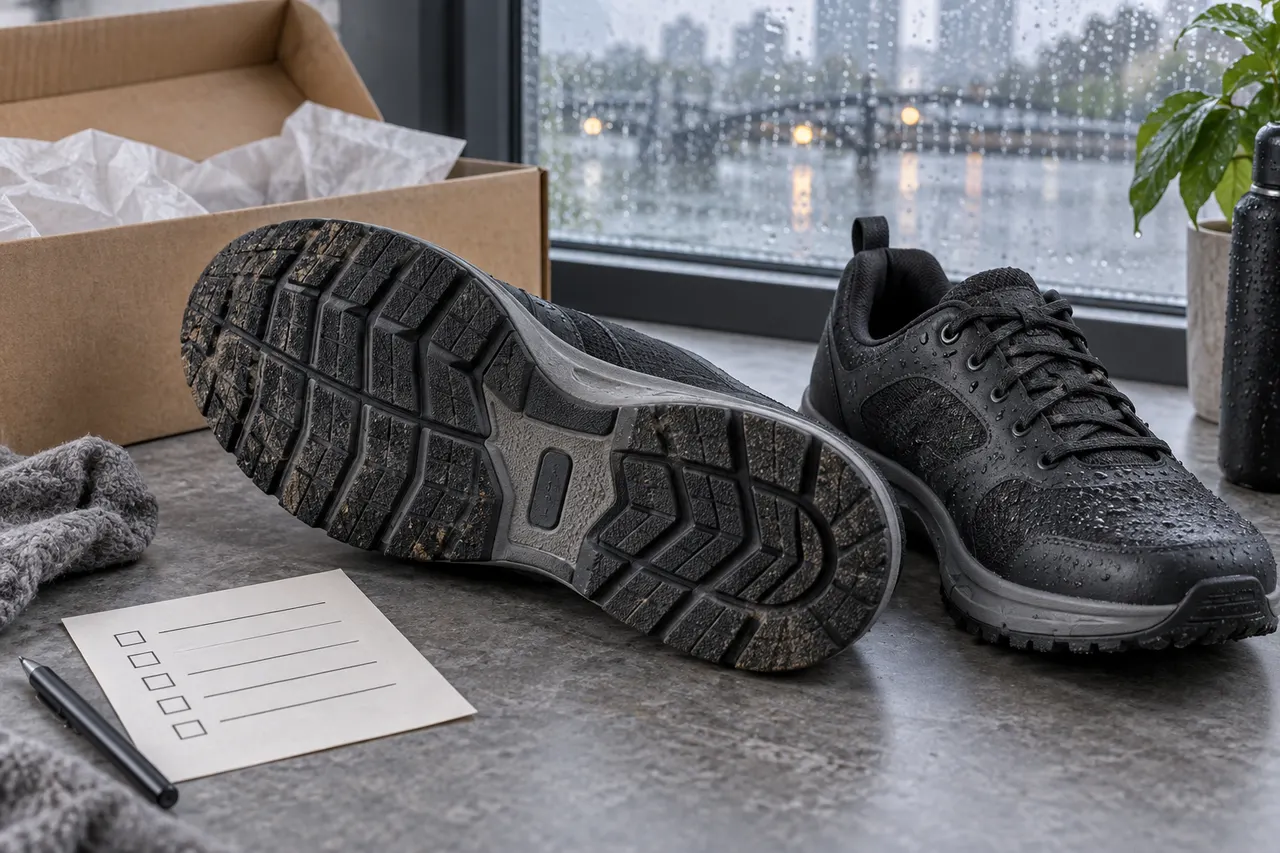
The first step is to look at outsole coverage. Rainy commute shoes need rubber or clearly non-slip material to cover the forefoot, heel, and outer edges; if there is only a small patch in the middle, or large areas of smooth foam directly contact the ground, the risk on wet surfaces is higher. 🌧️
The second step is to look at tread direction. Tread suitable for daily wet conditions is usually not purely decorative lines, but grooves that allow water to drain outward from the sole contact surface. Horizontal tread helps with braking, longitudinal and diagonal grooves help channel water away, and block or herringbone patterns provide multiple biting edges. On the contrary, large flat surfaces, shallow embossed lines, overly fine wavy patterns, and designs with tread only on the edges are not suitable as priority options for rainy commutes.
The third step is to look at ground contact continuity. Some soles look like they have a lot of tread, but actually the contact is on a few protruding flat areas; some thick-soled shoes have exaggerated edges but are flatter in the middle. When looking at product images, pay special attention to the bottom of the sole, not just the side profile.
| Checkpoint | More suitable to continue considering | Needs caution |
|---|---|---|
| Forefoot coverage | Forefoot has large rubber contact area, grooves in flex zone | Forefoot center smooth, only edge patches |
| Heel coverage | Heel landing area has horizontal or block tread | Heel is a large flat surface or shallow pattern |
| Drainage direction | Grooves can drain outward, forward/backward, or diagonally | Tread is closed, very shallow, or purely decorative |
| Outer edge | Outer edge has wear-resistant tread and ground contact blocks | Outer edge thin, smooth, prone to uneven wear |
How to Record Wear-Prone Areas: Forefoot, Heel, and Outer Edge
During commuter walking, the three areas most easily worn are: forefoot push-off area, heel landing area, and outer edge. When choosing shoes, do not only look at the center of the sole, because many people actually wear fastest on the outer heel and the transition between inner and outer forefoot.
It is recommended to record each candidate shoe as a short note, rather than comparing based on impression:
- Forefoot: whether there are horizontal grooves, whether the flex zone is covered by tread.
- Heel: whether there are independent tread blocks, whether the landing position is too flat.
- Outer edge: whether the outer edge of the sole has wear-resistant rubber, whether it is prone to be worn into a slope.
- Midfoot: whether there is a large hollow or non-contact area, affecting wet stability.
- Tread depth: whether the product image can show real texture, or only embossed effect.
If two pairs of shoes are similar in price, prioritize the one with more complete coverage of key stress areas, clearer tread, and easier QC confirmation. Rainy commutes are not just about appearance; missing sole information itself is a risk.
Upper Protection and Realistic Trade-offs on Wet Surfaces
Upper water repellency and sole grip are two different things. The upper can reduce light rain from wetting the top of the foot, but it does not solve slipping on wet tiles; clear sole tread does not mean the upper can withstand prolonged standing water. 👟
When looking at the upper, pay attention to three points: whether the toe cap has a cover, whether the tongue and collar are prone to water entry, and whether the upper material is largely mesh. If your commute includes outdoor walking, cycling transfers, or waterlogged sections, a pure mesh upper may not be suitable for rainy days even if the sole is good.
However, the more closed the upper, the more likely it is to be stuffy, slow to dry, and heavier. For ordinary commuting, a more realistic choice is "usable in light rain, not too slippery on wet ground, and can be worn normally in the office", rather than pursuing a shoe that simultaneously meets heavy rain protection, waterproofing, breathability, lightweight, and high grip.
Sole Angles to Request in QC Photos
kakobuy's warehouse inspection focuses on appearance confirmation, not functional testing. Buyers should treat QC photos as a tool to confirm actual item information, not as performance certification. After the item is stored, if the default photos do not clearly show the sole, you can prioritize requesting the following angles:
- Full sole front view: confirm forefoot, heel, and midfoot coverage.
- Forefoot close-up: confirm groove depth and tread direction in the flex zone.
- Heel close-up: confirm whether the landing area is smooth and whether there are clear ground contact blocks.
- Left and right sole comparison: confirm whether the two outsoles are consistent and free of defects.
- Upper front and side views: confirm light rain protection areas, glue overflow, open seams, or obvious indentations.
kakobuy provides a free storage period, and some items have a return/exchange window after warehousing; however, return/exchange services have exceptions, such as custom items, restricted items, adult products, intimate apparel, food, and items for which the buyer has requested the warehouse to remove packaging, tags, or accessories, which are usually not eligible. If the outsole information of rainy commute shoes is unclear, it should be addressed early in the warehousing period, rather than waiting until just before international shipping to decide. 🧾
When to Switch Candidates Instead of Risking an Order
Some shoes, even if you like the appearance, are not suitable as your main rainy commute shoes. In the following situations, it is better to switch candidates rather than rely on luck:
- Neither product images nor QC images show the complete sole.
- Large areas of the outsole are smooth, with only decorative tread on the sides.
- The heel landing area is a single flat surface without clear grooves.
- The forefoot flex zone tread is very shallow and easily worn smooth quickly.
- The upper is large-area thin mesh, but the usage scenario includes open-air rainy roads.
- The seller only emphasizes "trendy", "thick sole", "same style", without providing outsole details.
- The price is very low but the return/exchange conditions are unclear, and the trial-and-error cost is close to or exceeds the cost of switching candidates.
If the shoes are for style, collection, or short-distance indoor wear, you can lower the wet grip requirements; if the purpose is daily subway walking, stairs, catching buses, and crossing wet lobbies, sole evidence should come before appearance.
Final Action: Create a Rainy Commute Checklist
Before ordering, check the product detail page for clear sole images; candidates without sole images should be downgraded immediately. After warehousing, use kakobuy QC photos to confirm the actual outsole, forefoot, heel, outer edge, and upper condition. When additional photos are needed, prioritize full sole front view, forefoot close-up, and heel close-up. ✅
Finally, you can make decisions in this order:
- Confirm usage: whether it is really for rainy commutes, not just for dry indoor use.
- Filter product images: exclude styles with large smooth outsoles and no sole visibility.
- Compare key areas: whether forefoot, heel, and outer edge have effective tread.
- Check QC after warehousing: confirm the actual item matches product images, and request additional sole angles if necessary.
- Evaluate return/exchange window: if evidence is insufficient or risks are found, switch candidates early.
- Recheck before logistics: confirm size, appearance, sole, and return/exchange status before consolidation and shipping.
Savings come from reducing the probability of returns, repurchases, and idle shoes after receipt; the added cost is that requesting photos and waiting takes time, and some items may not be easily processed due to return/exchange restrictions. This method is more suitable for buyers who need to commute daily on rainy city roads but cannot try on Chinese e-commerce shoes in person. It is not recommended if you need professional-grade non-slip, waterproof certification, icy road protection, or explicit safety standards; in that case, prioritize professional products with certified parameters and testable information.
Agent Platform Shopping FAQ
1. How can I tell the quality of a product on kakobuy?
To judge product quality, kakobuy recommends checking QC photos instead of relying only on factory-provided images, which are often retouched. Use QC photos to confirm whether the details of the product meet your specific requirements before deciding to actually purchase.
Also note that you should avoid buying extremely low-priced products on kakobuy, as such products are often of poor quality.
2. What types of products can be found in kakobuy's spreadsheet?
kakobuy's website spreadsheet covers footwear, clothing, bags, accessories, jerseys, perfumes, hats, scarves, belts, and various household and daily necessities.