Kakobuy Gym Shoe Lateral Stability Check: Sole & Heel
If your training includes squats, deadlifts, machine work, or frequent changes of direction, you can't just look for "soft and bouncy," "comfortable," or cushioning descriptions when choosing shoes. Lateral stability requires checking the sole platform, heel structure, and upper lockdown, then deciding whether that information matches your movement needs.

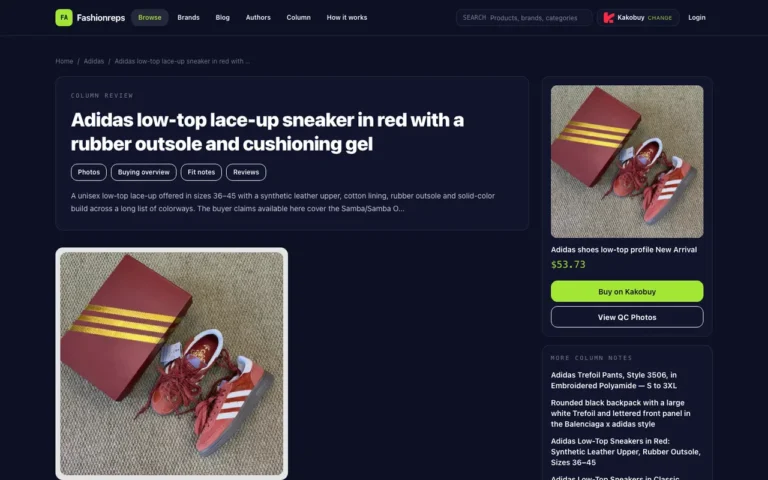
The page screenshot is for illustration only, not proof of physical product, quality inspection, or lateral stability.
Start by Distinguishing Needs Based on Training Movements
Strength training usually focuses more on whether the foot stays stable, whether the sole rolls noticeably under load, and whether the heel stays securely in the shoe. Machine work has fewer movement variations but still requires the foot not sliding forward or backward inside the shoe.
If training includes lateral movement, lunges, jumps, or quick direction changes, lateral support becomes more important. You can't just look at sole thickness; you need to judge whether the sole edges provide enough lateral support and whether the upper holds the foot centered on the platform.
Check the Sole Platform: First Shape, Then Firmness
After opening the product page, prioritize product images, sole details, and spec descriptions, and note the following:
- Whether the forefoot and heel are wider than the upper, especially if the outer edges show clear support area.
- Whether the outsole is relatively flat or has a pronounced curved or rocker design.
- Whether the heel has a distinct, relatively stable landing area.
- Whether the sole uses noticeably soft or high-rebound construction.
- Whether the page explicitly states suitability for training, lifting, cross-training, or change-of-direction movements.
A wide sole doesn't automatically mean lateral stability. A wide platform is only a favorable condition; you also need to consider sole shape, material compression, and foot lockdown inside the shoe. Conversely, softness and rebound mainly indicate foot feel or cushioning leanings and cannot alone prove the shoe is suitable for lateral forces.
Check Heel Lockdown: Look for Verifiable Structural Descriptions
Heel lockdown can be checked from three aspects:
- Heel cup: Look for a relatively clear, well-wrapping structure in the heel area in images.
- Laces or straps: Confirm whether the upper provides adjustable lockdown for the midfoot and rearfoot.
- Upper material: Distinguish between just soft and conforming, and descriptions of support panels, reinforced layers, or structured wrapping.
If the page only says "comfortable," "lightweight," "breathable," or "good elasticity," those words are not enough to prove heel lockdown. When the page provides no information on heel structure, lockdown method, or training use, record it as "insufficient evidence" rather than assuming stability.
Record Page Facts and Editorial Judgments Separately
When filtering, you can organize information as follows:
| Record Item | Page Facts | Judgments That Can Be Made | Conclusions Not Directly Supported |
|---|---|---|---|
| Sole platform | Width, flatness, and edge shape visible in images or specs | Whether there is a basis for further assessment of lateral support | Cannot confirm actual performance under load from appearance alone |
| Heel structure | Descriptions of heel cup, laces, straps, or support panels | Whether heel lockdown evidence is sufficient | Cannot call ordinary upper wrapping a lockdown feature |
| Cushioning and rebound | Material or foot-feel descriptions clearly stated on the page | Judge whether the shoe leans cushioning or stability | Cannot use softness or rebound as stability evidence |
| Training use | Sports scenarios explicitly stated on the page | Judge relevance to target training | Cannot rewrite commute or casual use as training certification |
This kind of record-keeping prevents writing personal impressions as product facts and reveals whether page information is sufficient to support a purchase decision.
What Current Page Evidence Can Tell Us
The current page is a shoe category listing page, which can confirm the existence of a footwear collection and basic catalog information, but it does not provide sufficient lateral stability testing, heel lock data, or specific training performance evidence. Therefore, you cannot assert from this page alone that a particular shoe is suitable for strength training, change-of-direction training, or high-intensity lateral movements.
If specific products on the page do not show sole details, heel structure, or training use descriptions, you should refrain from drawing stability conclusions. Prices, promotions, or shipping notes on the catalog page also cannot substitute for sole and heel structure evidence.
Complete Filtering According to Your Movement Needs
Make your final judgment in this order:
- First determine whether your training includes lateral movement, quick direction changes, or single-leg loading.
- Then check whether the sole platform is flat and whether edges have support space.
- Next look for clear evidence of heel cup, lacing system, and upper reinforcement.
- Keep "explicitly stated on page" and "judgment based on images" separate.
- For pages that only describe cushioning, softness, or rebound, mark as insufficient stability evidence.
- Finally confirm sizing, return policy, and actual availability; do not fill in information the page does not provide.
For those focused on strength training, stability, control, and heel lockdown are usually more important to check than softness alone. For those doing lots of jumping or direction changes, also pay extra attention to sole edge support and upper lockdown in the midfoot/rearfoot area. If the page provides none of this evidence, the safest conclusion is not "stable" or "unstable" but "currently unverifiable from the page."