Kakobuy Compression Sock Workflow
Split Compression Sock Filtering Tasks by Device and Time
When buying compression socks, the real problem to solve is usually not "how many products to view," but how to filter out worthy candidates for review within limited time, and leave enough evidence to avoid placing an order when size, sock height, compression level, or return/exchange conditions are unclear.
This guide is for those who need to find Chinese products on kakobuy, browse on phone first, then organize candidates on computer. After reading, you should be able to do three things:
- Quickly eliminate obviously unsuitable products on mobile.
- Record size, material, usage scenario, and evidence status on desktop.
- Identify what information is still missing before submitting for agent purchase or warehouse inspection.
It is not suitable for those who already have complete medical advice and need to select compression level based on prescription, or those who want to judge actual compression value solely from product title. Compression socks involve wearing comfort and personal health conditions; when the product page does not clearly state, do not guess.
Current information shows that kakobuy provides agent purchasing, warehousing, quality inspection, and international shipping for Chinese products. The total agent fee consists of product cost, international shipping, and customs declaration fee; international shipping is also affected by weight, route, and destination region. Platform information verification date is September 16, 2026, specific orders should still be based on checkout page and customer service confirmation. 📱
What kakobuy Website Spreadsheet is Suitable for Quick Discovery
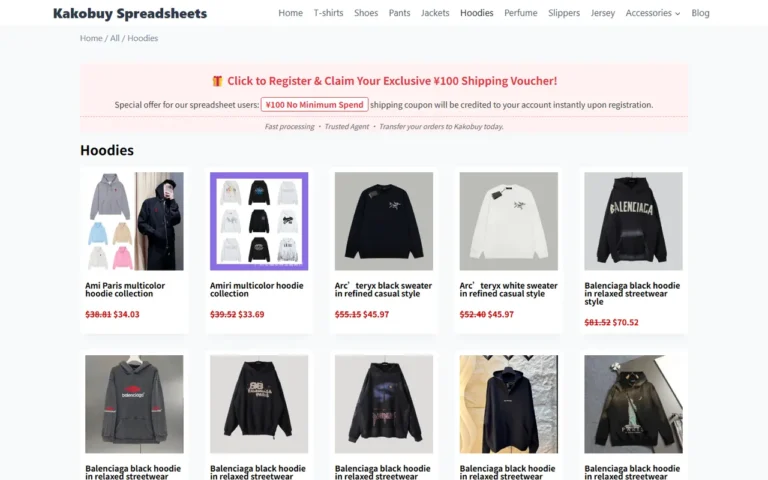
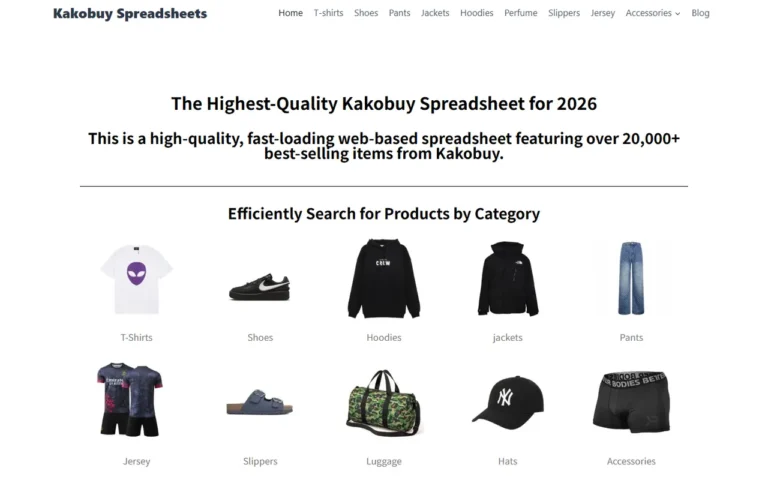
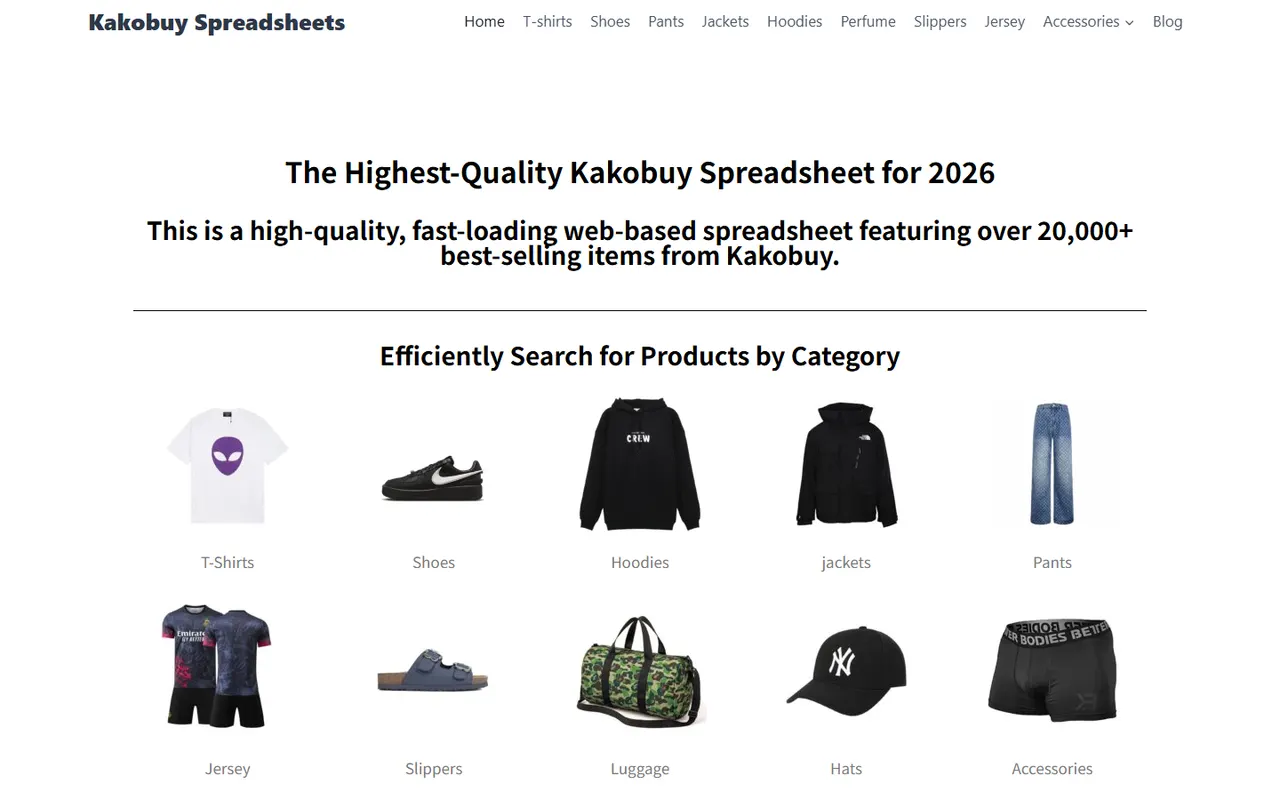
If you use Spreadsheet or similar product list view on kakobuy website, it is more suitable as a "quick filter layer" rather than a long-term research database. The focus on mobile is to quickly judge whether a candidate is worth keeping, not to complete all comparisons at once.
Mobile quick filtering can first look at the following:
- Whether product title clearly states compression socks, gradient compression socks, or similar descriptions.
- Whether images show sock height, toe area, and main structure.
- Whether page provides size chart, instead of only S, M, L without foot length, calf circumference, or applicable range.
- Whether compression unit, compression level, usage scenario, or wearing advice is marked.
- Whether quantity, color, and style match your needs.
- Whether seller page is accessible and information sufficient for next verification.
The goal of quick filtering is to remove obviously unsuitable pages. For example, pages with only vague promotional words, no size basis, no compression information, or the product is actually ordinary sports socks should be marked as "pending verification" or "excluded," not inferred as having medical-grade compression effect from images.
Website-side candidate records can keep only minimal fields: product name, page identification, initial purpose, missing information, and next action. This way mobile browsing is not slowed by too many fields, and avoids treating a large number of unverified products as final candidates.
How Google Sheets Stores Sock Height, Usage Scenario, and Evidence Status
Google Sheets is more suitable for in-depth organization on desktop. Its value is not in piling products into a bigger list, but in allowing every judgment to trace back to specific evidence.
Suggested fields for each candidate:
- Product name and page identification.
- Sock height: ankle, calf, knee-high, or page not specified.
- Usage scenario: sedentary, travel, sports recovery, daily wear, or not specified.
- Compression information: explicit value, explicit level, vague promotion, or missing.
- Size basis: foot length, calf circumference, thigh circumference, shoe size, or no available basis.
- Material description: page explicitly lists, partially lists, or not specified.
- Color and quantity requirements.
- QC focus points: color, quantity, size, style, appearance, and packaging status.
- Evidence status: confirmed from product page, need seller confirmation, waiting for QC photos, or cannot confirm.
- Purchase decision: keep, observe, exclude.
"Evidence status" is especially important. It prevents treating marketing words in product title as verified attributes. For example, title says "high pressure" does not mean page provides comparable compression values; image shows high sock height does not mean seller explicitly promises actual height.
When organizing on computer, information can be divided into three layers:
- Confirmed: directly displayed on product page, or explicitly replied by seller.
- Pending confirmation: need to ask seller, or need to wait for warehouse to take QC photos.
- Unconfirmable: no reliable basis from page or follow-up information.
Only the first layer is suitable for direct comparison. The second layer can be kept as candidate, but confirmation must be completed before order. Do not fill the third layer with speculation.
How to Link Mobile Quick Browsing and Desktop In-depth Organization
The most stable way is to use the same candidate ID. On mobile, whenever a candidate is found, record a short ID and minimal information; on desktop, use the ID to fill in evidence, measurement requirements, and decision status. Do not rely solely on browser history, because pages may change and multiple products can get mixed up.
You can use the following process:
- Mobile: open product page, first judge whether it belongs to target category.
- Mobile: record product name, page identification, and most obvious missing items.
- Mobile: only add pages worth reviewing to candidate list.
- Desktop: fill in size, sock height, compression, and material one by one according to candidate ID.
- Desktop: leave unconfirmable fields empty, and write reason for needing confirmation.
- Before ordering: check whether product cost, domestic shipping, international route, and customs declaration fee have been identified separately.
- After warehousing: verify style, quantity, color, size, model, and appearance according to kakobuy's inspection scope.
kakobuy information shows that QC mainly checks style, quantity, color, size, model and other appearance information, and checks for prohibited items. Sealed package products may be inspected for appearance and packaging information without opening. Therefore, QC photos can help confirm quantity, color, size marking, and appearance status, but cannot automatically prove actual compression value, fiber content, or wearing effect. 🧾
Operational Differences Between One-time Search and Long-term Candidate Maintenance
If you are just looking for a pair of compression socks for one trip, recording focus should be on current purpose, available sizes, clear price, and acceptable shipping time. The filter sheet does not need long-term maintenance, but at least record reasons for exclusion to avoid reviewing the same pages repeatedly.
If you buy frequently, or need to compare different sock heights and usage scenarios, Google Sheets is more suitable as a long-term candidate library. Each time you revisit, update page status, price, stock, seller information, and verification date. Prices, stock, logistics routes, and policies may change, old records cannot be treated as current facts.
One-time search can use fewer fields:
- Whether category matches.
- Whether available size information exists.
- Whether clear compression description exists.
- Whether worth further verification.
Long-term maintenance should add:
- Latest verification date.
- Previous price or quote records.
- Route notes for different destination countries.
- Issues found, such as size inconsistency or insufficient page information.
- Return/exchange restrictions and special product notes.
- Items to recheck after warehouse QC.
According to current platform information, kakobuy offers a 5-day no-reason return/exchange service within 120 hours after warehousing, but special products like intimate apparel may not apply, and after removing packaging, tags, or accessories, the service may not be supported. Whether compression socks are classified into specific restricted categories should be confirmed with the platform before purchase, not judged solely by product name. ⚠️
How to Avoid Guessing When Size and Compression Information Are Missing
The most common mistake with compression socks is using shoe size or ordinary sock experience to replace compression sock size basis. Different sellers may have different size divisions, and the page may require foot length, calf circumference, or other measurements. When there is no corresponding size chart, record "size basis missing" rather than directly selecting your usual size.
Compression information should also be handled separately:
- Page has explicit unit or level and explains applicable range, can enter comparison stage.
- Page only says "support," "tight," or "high elasticity" without compression basis, only mark as promotional description.
- Page has no compression information at all, should ask seller; if cannot confirm, do not write it as compression level.
- If you have venous, circulatory, post-surgery, or other health-related needs, first determine selection boundaries according to professional advice, then judge whether product page meets requirements.
When asking seller, you can ask key facts at once: what measurements correspond to available sizes, how sock height is defined, whether there is compression value or level, what is material ratio, whether color and quantity match page. Reply should be saved in evidence field of the sheet, and date recorded.
Desktop can also set a simple "pre-order check" list: size basis confirmed, compression information confirmed, quantity confirmed, return/exchange restrictions confirmed, total cost reviewed, destination country import restrictions self-checked. If any item is "unknown," pause order or continue asking.
Applicability Boundaries of Combining Website and Spreadsheet
The combination of website and Google Sheets is suitable for tasks like: mobile responsible for discovery and elimination, computer for comparison and evidence keeping, kakobuy order and warehouse QC for subsequent product status verification. It cannot replace seller's formal statement on compression parameters, nor can it replace destination country's requirements on import restrictions, taxes, and declaration documents.
Regarding costs, do not treat the spreadsheet itself as a guarantee of savings. You can compare different plans in the following ways:
- Plan total cost = product cost + domestic shipping within mainland China + international shipping + customs declaration fee and other explicit fees.
- Combined shipping savings = estimated total of separate shipments − estimated total after combining.
- Additional risk after combining = changes in package value, volumetric weight, single loss exposure, and route restrictions.
Without actual product weight, packaging dimensions, destination country, and route quotes, it is impossible to responsibly give specific savings amount. Combining may reduce duplicate first weight or operation costs, but may also increase volumetric weight and single loss risk; separate shipping may increase fixed costs, but may be more suitable for route restrictions or high-value products. Final comparison should be based on kakobuy's current quote and your product list.
This workflow is suitable for buyers who need repeated comparison, value evidence recording, and are willing to confirm missing information before ordering. It is not recommended for those who just want to buy quickly, cannot verify size and compression information, or are unwilling to bear uncertainties of cross-border shipping and customs clearance.
Final Action: Determine Quick Filter, Review, and Order Record Process
You can start with a minimal sheet, not necessarily a complete database at first:
- First column: candidate ID.
- Second column: product name and page identification.
- Third column: sock height, usage scenario, and compression description.
- Fourth column: size basis and missing information.
- Fifth column: evidence status and next action.
- Last column: keep, observe, or exclude decision.
Mobile only responsible for excluding obviously unsuitable pages and leaving candidates worth review. Desktop responsible for filling comparable information and clarifying which conclusions still cannot be confirmed. After submitting order, keep product, cost, route, and declaration information; after warehousing, verify observable appearance items based on QC photos.
What this may save is cost of repeated searching, repeated asking, and rework after wrong selection, not a fixed amount that can be guaranteed in advance. Increased risks mainly come from cross-border shipping, concentrated loss after combining, destination country taxes, and insufficient page information. Suitable for those who value records and review; when size, compression, return conditions, or import requirements cannot be confirmed, it is not recommended to continue ordering just to complete the sheet. ✅
Common Questions for Agent Platform Shopping
1. On kakobuy, what do QC photos refer to?
All agent platforms have a dedicated quality control expert team. After your items arrive at kakobuy warehouse, the platform conducts quality inspection and takes QC photos of your items. Usually three photos are taken, and the team verifies whether the color, size, specifications, and quantity of the items match your order, and also checks for quality issues. However, electronics are excluded and only their appearance is checked. If quality issues or wrong size/color are found, the team will immediately request a return from the seller to ensure you receive good quality products.
2. Why use a spreadsheet on kakobuy?
Agent platforms usually do not display products directly, so you need a spreadsheet to search for items you like and find purchase links. Also, you can seek help on Reddit or Discord—products recommended there are often great, but the shopping process can be quite slow. These spreadsheets are usually compiled by collecting information from those platforms over time.