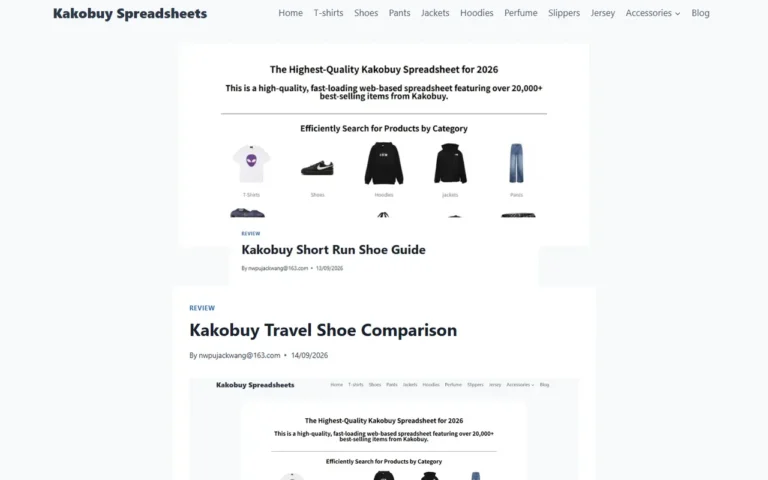
How to Browse Kakobuy Football Jerseys in Spreadsheets
How to Browse Kakobuy Football Jerseys in Spreadsheets
If you're browsing football jerseys and finding more and more candidate styles on the page, the easiest mistake to make isn't "can't find the product"—it's mixing up different colors, different season clues, or different size information. This article tackles just one task: first discovering candidates from Kakobuy's Spreadsheet category, then using Google Sheets to build a reviewable jersey list to help you pause and avoid misjudgments before placing an order. ⚽
This article is for readers who need to organize multiple candidates, compare page information, and record items to verify; it's not for those who already have complete size charts, version details, and inventory evidence and are ready to decide on a purchase directly. After reading, you should be able to create a candidate table that includes images, titles, page URLs, style clues, size evidence, and verification status.
What Purchase Tasks to Define Before Browsing the Football Jersey Category
Before starting to browse, break down "I want to find a jersey" into a few recordable tasks:
- Find candidates that match the target team or color direction.
- Distinguish page clues such as home, away, training, or retro styles.
- Record whether the page shows size, version, or other key options.
- Preserve the correspondence between images and titles to avoid being unable to confirm sources later.
- Mark unverified information as "to be checked" rather than treating it as fact.
The key in this step is to establish judgment boundaries. Page images can help discover candidates, but they alone cannot prove accurate sizing, consistent versions, valid inventory, or seller-confirmed details. When information is insufficient, the correct action is to pause and record as "to be checked," rather than filling in missing content with similar pages. 🔎
How Kakobuy's Spreadsheet Discovers Candidates by Category and Image
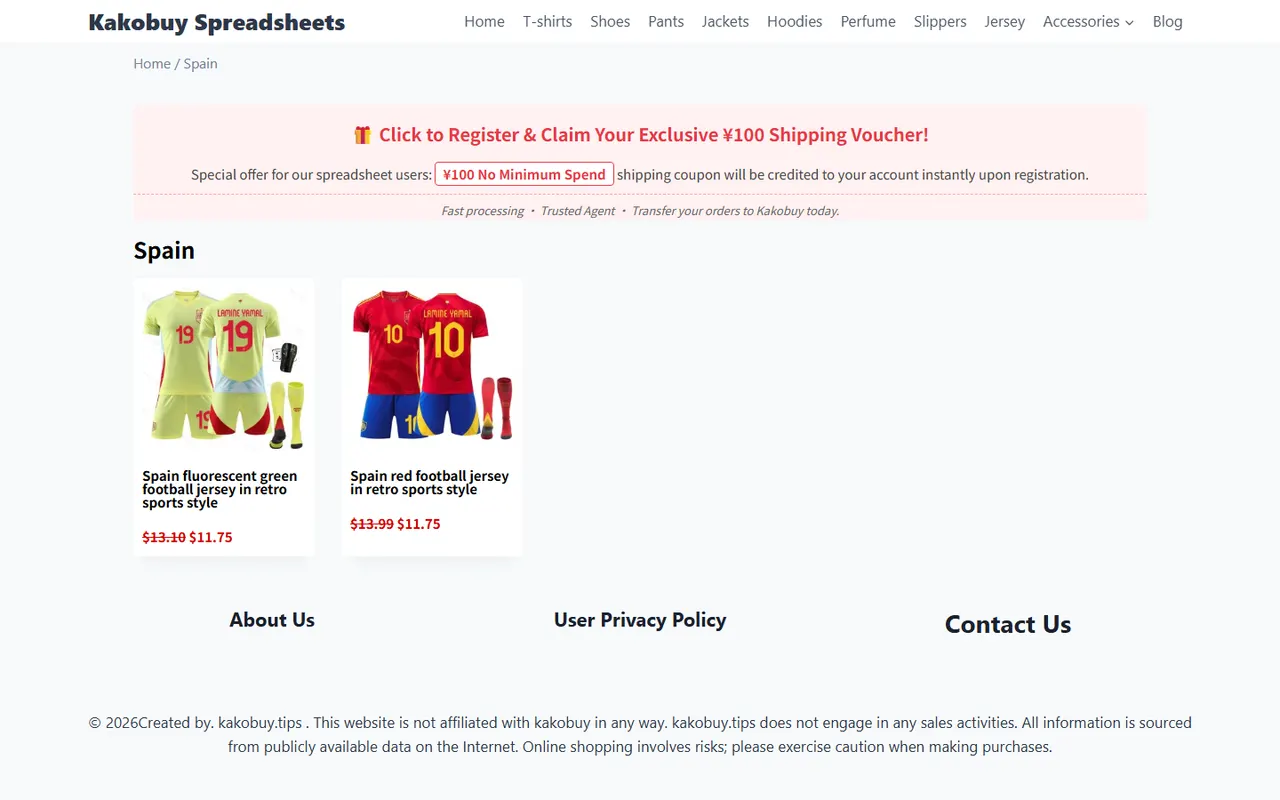
Based on the provided page screenshots, the Spreadsheet page displays multiple product category entries, including Jersey. When browsing, you can first enter the category related to jerseys, then initially filter candidates based on the images and visible titles in the page cards.
It is recommended to operate in the following order:
- First confirm that you are browsing the jersey category, not other apparel or accessory categories.
- Look at each card image one by one and record visible clues such as color combinations, pattern positions, and overall fit.
- Read the card title and extract only what is actually displayed on the page.
- Keep the original page URL for each candidate so you can re-check later.
- Do not merge two candidates into one row just because the images look similar.
The screenshot shows football jersey candidates in different color directions. Color is an initial screening clue, not a complete proof of style; the same color may correspond to different designs, size ranges, or page versions. Therefore, the goal of the image browsing stage is only to establish a candidate pool, not to complete the purchase judgment. 🧭
How Google Sheets Records Team Style, Size, and Version Fields
Google Sheets is better suited for organizing and filtering. Use one row per candidate to avoid cramming multiple pages into one cell. You can set up the following fields:
candidate_id: Custom ID, e.g.,FJ-001.title_visible: The title actually displayed on the page.page_url: Candidate page URL.image_note: Visible clues in the image such as colors, patterns, or fit.team_or_theme: Fill in team or theme only when the page or image clearly supports it.season_clue: Fill in if the page clearly shows season clues; otherwise leave blank.size_evidence: Record size chart, size options, or "Not shown."version_clue: Record version information explicitly shown on the page; do not infer.accessory_note: Record whether the page explicitly mentions included accessories.source_checked_on: Date of this viewing.status: Use statuses such as "Candidate," "To Check," or "Excluded."reason: Explain the specific reason for keeping, pausing, or excluding.
Among these, title_visible, image_note, and page_url are the first three columns to fill in. If there is no evidence for size, season, and version information, you can explicitly write "Not shown" rather than leaving it blank to avoid others mistakenly thinking it's confirmed.
How to Establish Row-by-Row Correspondence Between Product Titles, Images, and Links
A practical recording principle is "one row per page candidate." The title, image observations, and page URL must come from the same row's page, not pieced together from different candidates.
You can review as follows:
- After copying the title from the page, immediately fill in the candidate ID.
- In the same row, record clues that are directly visible in the image.
- After pasting the page URL, reopen it to confirm the address still corresponds to that title.
- If the page redirects, is invalid, or content changes, change the status to "To Check."
- If the image and title are clearly inconsistent, do not replace it with information from other pages.
Do not expand the short title in search results into a full product description, and do not write speculation from the image into fields that the page has confirmed. The value of a table lies in preserving evidence boundaries, not making every row look complete. 📝
How to Distinguish Color, Season Clues, and Accessories Among Multiple Jersey Candidates
When the number of candidates increases, it is recommended to use a fixed order of distinction: first look at color and main patterns, then check whether the page provides season or version clues, and finally check whether accessories are explicitly mentioned.
Color records should be as specific as possible, e.g., "dark base, light stripes" or "bright base, contrasting details," rather than simply writing "nice" or "similar to some style." If the page does not explicitly state the team, season, or version, write "Page not shown" and do not infer based solely on color, badge style, or design impression.
Accessories should also be recorded separately. Accessories explicitly mentioned on the page can be written into accessory_note; items not mentioned should not be assumed included just because similar elements appear in the image.
Efficiency Boundaries Between Website Card Browsing and Spreadsheet Filtering
Website cards are good for discovering candidates because images and titles usually help you quickly establish an initial range. Google Sheets is good for managing candidates because it can filter by color clues, size evidence, verification date, and status.
The division of labor can be simply understood as:
- Website pages are responsible for discovering and re-verifying original information.
- Google Sheets is responsible for sorting, deduplicating, marking gaps, and keeping judgment records.
- Images provide visible clues and cannot replace size or version evidence.
- The spreadsheet shows which candidates are still undecidable and cannot create information that doesn't exist on the page.
When the number of candidates is small, browsing the page directly may be faster; when the number increases, colors are similar, or collaboration is needed, the value of a spreadsheet becomes significantly higher. But if the page information itself is insufficient, adding more spreadsheet columns will not automatically improve the reliability of conclusions.
How to Pause Judgment When Size or Version Evidence Is Missing
In the following situations, it is recommended to change the candidate status to "To Check":
- The page has no visible size options or size chart.
- The image and title cannot confirm whether they belong to the same style.
- The page only shows color and does not specify version or season clues.
- The page URL is invalid, redirects, or opens to empty content.
- Candidate images are similar, but the title and page information cannot prove they are the same.
- The page mentions accessories in an unclear way, making it impossible to determine if they are included in the candidate.
Pausing judgment is not giving up on the candidate, but avoiding bringing uncertain information into the next step. You can write the missing evidence in reason and record the most recent viewing date in source_checked_on. This way, when re-checking, you can quickly identify which rows need priority review. ✅
Final Actions: Complete the Jersey Candidate List and Pre-Order Checklist
After completing the initial organization, first filter out rows with status "Candidate," then check row by row whether the title, image, page URL, and size evidence belong to the same page. For rows still marked "To Check," do not treat them as confirmed candidates.
Before ordering, complete at least the following checks:
- The target color or style clue matches the page image.
- The page title and page URL correspond to each other.
- Size information has been found, or you clearly know that evidence is still missing.
- Version, season, and accessory information has not been subjectively filled in.
- The most recent verification date has been recorded.
- Candidates with invalid pages, redirects, or information changes have been reconfirmed.
This method saves time from repeated searching and erroneous organizing, at the cost of needing to maintain records row by row. It is more suitable for those who need to compare multiple candidates and value evidence correspondence; if you only need to browse one page and do not plan to compare multiple options, building a complete spreadsheet may not be necessary.
Agent Platform Shopping FAQ
1. Which platform has the biggest coupon discount?
kakobuy currently offers the most favorable deals because users can use a $15 discount code without meeting a minimum purchase requirement. This is especially beneficial for those ordering small packages. The valid coupon code is kakobuy888.
2. What are kakobuy's QC photos?
kakobuy has a dedicated quality control team. When your items arrive at kakobuy's warehouse, the platform conducts quality inspections and takes QC photos. Typically three photos are taken, and the team checks whether the item's color, size, specifications, and quantity match the order, and also checks for quality issues. However, electronic products are excluded and only the external appearance is checked. If quality issues or size/color errors are found, the team will immediately apply for a return from the seller to ensure you receive good quality products.
3. How do I view QC photos on kakobuy?
When viewing QC photos, focus on the specific features of the purchased item. For example, for shoes, check several key parts—such as the toe, heel, and tongue—to confirm stitching, shoe construction, and tongue thickness, to judge whether it's a high-quality product. For clothing, check details such as collar tags, logo embroidery, fabric, and the flatness of collars and cuffs.