Kakobuy Hat Color Notes for Accurate Packing
This article addresses a specific problem: when a hat order includes multiple colors, different sizes, or attached accessories, how to organize checkable information into clear notes to reduce selection errors before package consolidation. After reading, you should be able to create a reviewable archive record for hat orders and pause selection when information is insufficient or conflicting. This article is not a substitute for the platform's actual order page, warehouse inspection results, or after-sales policies; before ordering, always refer to the currently visible page and order status.
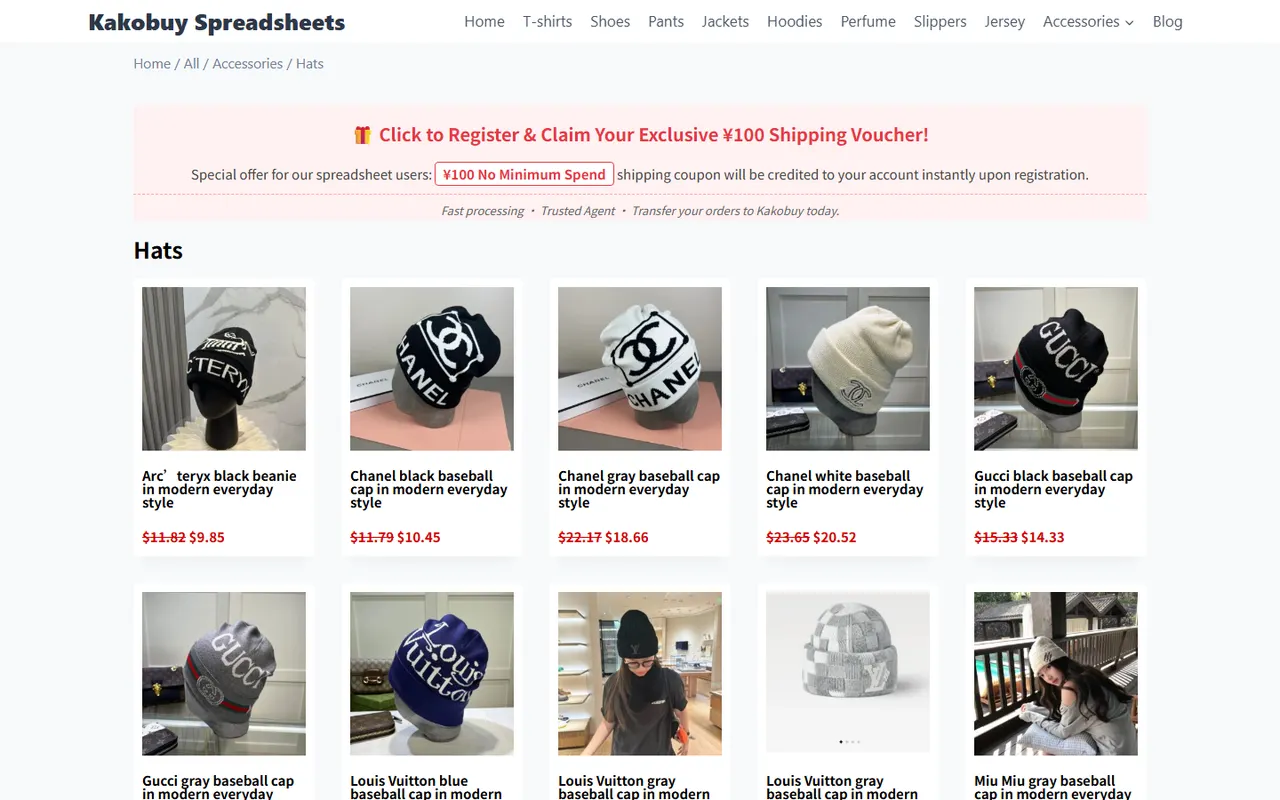
Verification scope: This article is based on provided screenshots of Kakobuy-related pages and visible category information, with a verification date of October 13, 2026. The screenshots can only support categories and product display information actually visible on the page, and cannot prove unshown buttons, fields, inventory, sizes, accessory contents, or warehouse processing results.
Define the Problem: Hat Order Archiving
The focus of hat archiving is not to make notes longer, but to quickly answer four questions during review: Which item is this? What color is needed? Are there size or specification requirements? What has been confirmed and what still needs verification?
It is recommended to treat each hat as an independent entry and avoid merging multiple styles into one sentence. Especially when the same page displays different colors, hat shapes, or styles simultaneously, separate records can reduce ambiguity during warehouse selection.
A qualified archive record should at least include:
- Order or item identification: Use the actual visible number, title, or image position from the order page.
- Color information: Record the original page text, the user's understood color, and whether there are similar colors.
- Size or specification: If the page does not show a size, explicitly write "No size information visible on page," and do not fill it in yourself.
- Accessory information: Distinguish between content shown with the product, requirements in order notes, and unconfirmed content.
- Evidence location: Note whether the information comes from the product page, order records, warehouse images, or other reviewable sources.
- Current status: Confirmed, pending verification, conflicting, or needs to be paused.
Establish Unified Fields for Color, Size, and Accessories
The purpose of unified fields is to reduce natural language differences. For example, "dark gray," "gray black," and "nearly black" may represent different judgments, and cannot be automatically treated as the same color without evidence. When archiving, keep the original page text and add internal understanding to avoid leaving only vague abbreviations.
You can use the following field order:
- Item number
- Visible name on page
- Original color text on page
- Archive color label
- Original size or specification text
- Original accessory text
- Order notes
- Current evidence
- Confirmation status
- Action before consolidation
Color labels are best expressed as "original text plus explanation," for example, "Page text: gray; Archive label: gray, unconfirmed whether darker." This preserves page information and does not disguise subjective judgment as a platform field.
If the page only shows a color image without text, record "Color text not displayed, need to verify with image or order records." If the image itself cannot clearly distinguish colors, do not write a definite color. 👀
Verify Visible Differences Using Product Page and QC Images
When verifying, first look at the actual content displayed on the page, then review QC images or other order evidence provided by the warehouse. The uses are different: the page mainly helps identify items and options, while QC images mainly help confirm whether the physical appearance matches the record. Images cannot automatically prove material, comfort, authenticity, or unshown accessory contents.
It is recommended to proceed in the following order:
- First confirm which order or item entry the page record corresponds to.
- Compare the visible color, hat shape, pattern, and specification text on the page.
- Check whether the QC image shows the main body of the hat, color, and attachments that may affect selection.
- Record "page display" and "image display" separately, and do not rewrite image observations as platform promises.
- If the image angle, lighting, or obstruction prevents judgment, mark it as pending verification.
For example, if the image looks darker, it does not necessarily mean the wrong color was sent; it could be related to lighting, screen display, or shooting environment. Only when order records, page options, and QC images correspond can the color status be marked as confirmed.
Image verification should also pay attention to accessory boundaries: packaging, display items, or shooting aids in the picture are not necessarily part of the order content. Unless the page description or order information explicitly includes them, record as "Appears in image, whether included with order unconfirmed." 📷
Separate Confirmed Options from Alternatives
Confirmed options and alternatives must be stored in separate columns. Writing both in the same sentence can be misread during consolidation as "choose either" or "replacement already agreed."
It is recommended to use three statuses:
- Confirmed: Page, order records, and visible evidence correspond.
- Pending verification: Missing key information, but no obvious conflict for now.
- No substitution accepted: User only accepts the original option, and any change requires pausing.
If the user allows substitution, also specify the conditions, such as only accepting the same color range, or only replacing after confirmation. Do not use expressions like "almost," "whatever," or "pick by eye" that cannot be executed.
For options with similar colors, prioritize keeping the original page text instead of only writing internal abbreviations. For accessories, also distinguish "must include," "keep if page explicitly includes," and "unconfirmed, do not add on your own." This reduces the risk of warehouse substitutions based on experience. 📝
Handle Duplicate Items, Missing Images, and Incomplete Descriptions
When encountering duplicate items, do not judge whether they are the same based solely on the title. At least compare page position, color text, specification information, image features, and order item identifiers. If still indistinguishable, create two separate entries and note "Possible duplicate, need confirmation before consolidation."
When encountering missing images, record what type of evidence is missing: main product image, color image, accessory image, or QC image. Different gaps correspond to different risks. Missing main image affects item identification; missing color image affects color selection; missing accessory image cannot prove whether attachments are included.
When encountering incomplete descriptions, do not use common sense to fill in. For example, if the page does not show size, do not assume it is one-size-fits-all; if the page does not mention accessories, do not assume they are included because similar objects appear in the image. The safest archiving method is to leave blanks and arrange for next-step verification.
If two entries use the same abbreviation, immediately change to more specific internal identifiers, such as "Entry A: Dark color, pending verification" and "Entry B: Light color, confirmed." Internal identifiers are only for distinction and should not replace original page text.
Pre-Consolidation Hat Note Review Checklist
Before consolidation, review in the following order:
- Does each hat have an independent entry?
- Can the visible name or identification information on the page correspond to the order record?
- Are both the original page text and archive label for color retained?
- If size or specification is missing, is it clearly marked instead of inferred?
- Are accessories noted with evidence source and confirmation status?
- Are confirmed options and alternatives separated?
- Are there duplicate items, similar colors, or same abbreviations?
- Are QC images sufficient to support the current judgment?
- Is any information from guessing, blurred images, or unverified descriptions?
- Can consolidation staff see at a glance which entries must not be substituted?
After review, it is recommended to keep a final status for each entry: confirmed, pending verification, or paused. Do not just write "processed," because this word cannot indicate whether color, accessories, and alternatives are truly verified. ✅
How to Pause Selection When Information Conflicts Arise
When page color, order notes, and QC images are inconsistent, pause selection; do not directly adopt one version to rush consolidation. First record both sides of the conflict, then confirm which item belongs to current order evidence and which is only display information or temporary judgment.
Common conflicts include: page shows one color, order notes state another; same item has multiple similar specifications; color in QC image is hard to judge due to lighting; notes require accessories, but page does not show accessory information.
Pause records can be written as:
- Conflict content: Page original text inconsistent with order notes.
- Currently cannot confirm: Final color or accessory status.
- Actions that should not be taken: Do not substitute on your own, do not choose by similar color, do not treat display items in image as accessories.
- Next step: Wait for new order information, clear images, or platform customer service confirmation.
The value of this record is to preserve decision boundaries. It cannot solve missing platform information, but can reduce unauthorized choices. If returns, storage deadlines, or additional fees are involved, also check the current applicable official policies; do not infer from hat images or archive notes.
Save Reviewable Final Archive Records
The final archive should save original page text, internal labels, evidence locations, confirmation status, and last review time. Do not only keep a compressed summary, because summaries may lose original color text, missing information, or pause reasons.
Recommended final record structure:
- Entry: Independent number or visible identification in order.
- Selection: Original page color, size, or specification.
- Accessories: Explicitly included, explicitly not included, appears in image but unconfirmed, or page not stated.
- Evidence: Page, order record, QC image, or other reviewable material.
- Status: Confirmed, pending verification, or paused.
- Consolidation instruction: Substitution allowed, substitution prohibited, or must ask first.
- Review time: Record the date of the most recent verification.
The goal of archiving is not to guarantee the platform never makes mistakes, but to make errors easier to detect, locate, and pause. For hat orders with similar colors, duplicate items, or incomplete accessory descriptions, clear records are often more helpful than longer descriptions. 🧾
If you cannot confirm an option, do not mark it as confirmed just to complete archiving. Retain uncertainty, point out the next evidence needed, and recheck before consolidation. That is the safer choice.