Kakobuy Casual Shoe Longevity Checks
Verification date: 2026-09-08. This article only discusses how to judge whether a pair of casual shoes is worth sending as an international parcel when purchasing through kakobuy, before ordering and during warehouse QC. It does not apply to professional running shoes, hiking shoes, safety shoes, and cannot replace long-term testing after actual wear.
What wearing tasks are these casual shoes suitable for
When purchasing casual shoes through kakobuy, the most suitable task is usually not pursuing extreme performance, but wanting to buy a pair of shoes that can be used for daily commuting, campus styling, short trips, or light walking. When judging "durability," don't just look at the style pictures or the seller's promotional words, but change the question to a more specific one: Under my usage frequency, can these shoes complete enough wears at an acceptable total cost? 👟
If your needs include long hours of standing every day, frequent wear in rainy days, sports training, or long-distance walking, ordinary casual shoes' product pictures and warehouse QC photos are usually not enough to prove their lifespan. At this time, you should choose candidates with clear material descriptions, outsole structure, size feedback, and after-sales conditions, rather than just ordering because the price is low.
The advantage of ordering through kakobuy is that after the goods arrive at the warehouse, you can first confirm the style, color, size, quantity, and obvious appearance issues through inspection pictures. According to platform information, kakobuy's inspection mainly checks appearance information and will conduct prohibited item screening; but it is not a laboratory abrasion test, nor will it do long-term trial wear for you. Therefore, durability judgment should be divided into two steps: look at product page clues before ordering, and look at risks visible in QC pictures after arriving at the warehouse.
First break down the value received into price, number of wears, and maintenance
Whether casual shoes are worth buying is not only determined by the product's selling price. When purchasing through a proxy platform, the total cost usually includes product cost, domestic shipping within China, international shipping, and possible customs fees. In kakobuy's fee structure, product cost includes product selling price and domestic shipping within China; international shipping is affected by weight, route, and region; customs fees generally depend on the shipping method.
A more practical calculation is:
Cost per wear = Total cost received ÷ Estimated acceptable number of wears
For example, if a pair of shoes has a low product price, but the outsole is very thin, the upper is prone to cracking at flex points, and the heel support is weak, you may need to replace the shoes soon. Another pair has a higher product price, but the outsole coverage is complete, the upper stitching is stable, and the insole is replaceable, its cost per wear may actually be lower.
Before ordering, you can make a simple estimate:
| Usage scenario | Suggested focus | Risk warning |
|---|---|---|
| Worn 1–2 times per week for styling | Style, size, basic workmanship | Acceptable slight abrasion risk |
| Worn 3–5 times per week for commuting | Outsole thickness, upper flex zones, heel support | Low-priced thin-soled models may wear quickly |
| Long walking every day | Sole structure, insole, weight, size stability | Difficult to judge long-term comfort from pictures alone |
| Rainy days or complex surfaces | Outsole tread pattern, upper material, glue edges | Ordinary casual shoes may not be suitable for high-humidity environments |
If you only wear them a few times for photos or styling, durability is not the only indicator; if you want them to serve as your main shoes, you need to factor in maintenance costs, return/exchange windows, and international shipping risks. 🧾
What initial clues can product page information provide
The most valuable information on a product page is not adjectives like "best-seller" or "high quality," but details that can be verified: upper material, lining material, sole material, size chart, weight, real-life photos, detail photos, buyer feedback, and seller's return/exchange instructions.
Before ordering, it is recommended to look in the following order:
- Check the upper description. Common casual shoes may use synthetic leather, fabric, mesh, suede, or mixed materials. For synthetic leather, pay attention to whether the flex zones are prone to wrinkling and cracking; for fabric and mesh, check edge binding and stitching; for suede, consider cleaning costs.
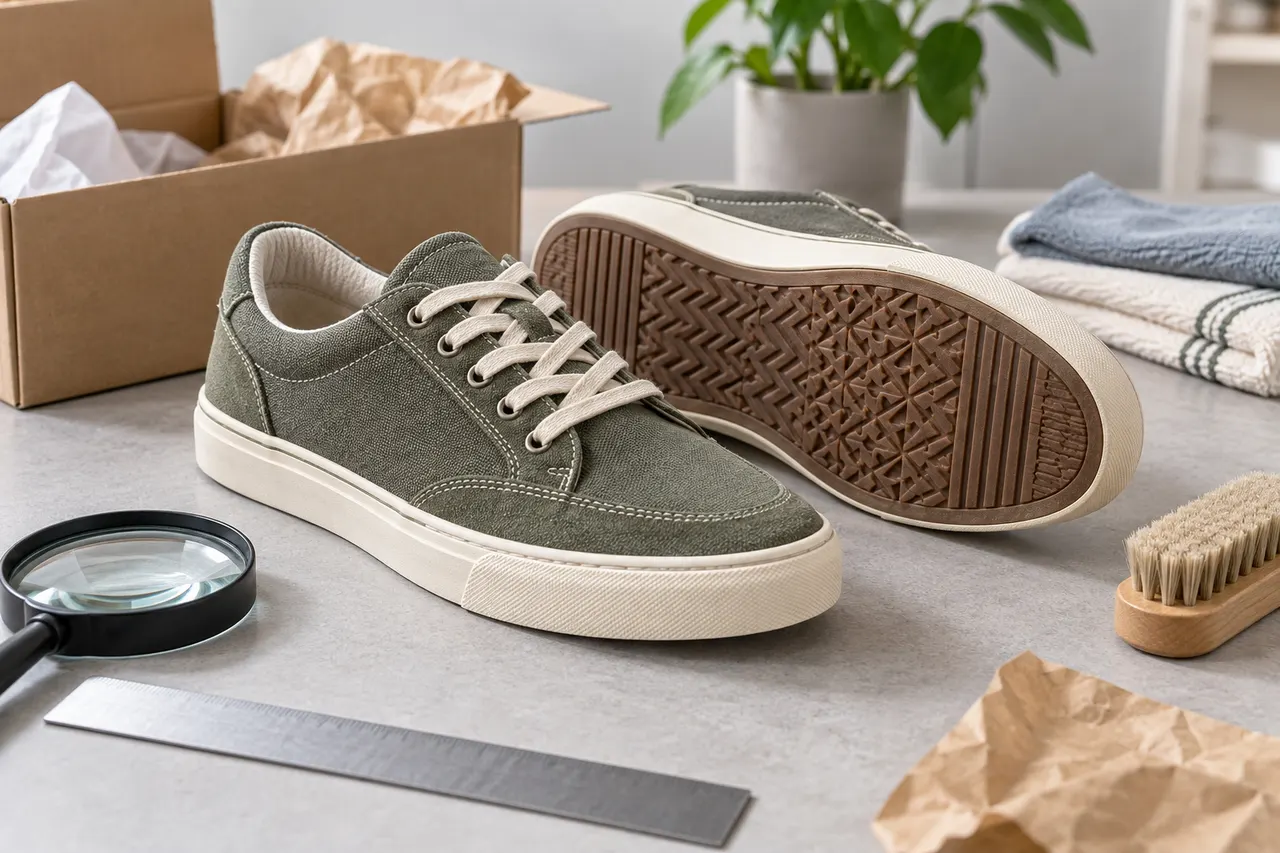
- Check the outsole pictures. The more complete the outsole coverage, the more suitable it usually is for daily walking; if the sole only has patches in certain areas, wear may concentrate and affect stability more quickly.
- Check the toe and heel. The toe is prone to scuffing, and the heel affects putting on/taking off and support. In pictures, if the heel is very soft and the collar is very thin, it may deform with repeated wear.
- Check the size chart. The most common wear on casual shoes comes not only from materials but also from improper sizing. Shoes that are too small will increase upper creases and toe pressure; shoes that are too large will make heel slippage more noticeable.
- Check the return/exchange conditions. kakobuy offers a 5-day no-reason return/exchange service within 120 hours after warehousing, but special products are excluded, such as custom items, restricted items, adult products, intimate apparel, food, and items where the warehouse has been asked to remove packaging, tags, or accessories. For shoes, the actual after-sales availability should still be based on the order.
If the product page lacks materials, lacks clear outsole pictures, lacks a size chart, and only shows a few ambiance photos to display the style, then it is not suitable for the expectation of being a "durable main shoe."
How to observe upper materials, stitching, and outsole coverage
Durability judgment can start from the three most easily observed parts: upper flex zones, seam stitching, and outsole contact surface.
Upper flex zones are above the forefoot, where repeated stress occurs during walking. If synthetic leather already looks very stiff, shiny, and has concentrated flex lines in the product pictures, subsequent creasing will be more obvious. Fabric and mesh are not necessarily more durable than synthetic leather, but if the edges are bound and key stress areas have reinforcement patches, the risk in daily use will be lower.
Stitching should be even along stress edges. Common problems with casual shoes include loose threads at toe seams, lifted decorative strips on the sides, weak tongue fixation, and loose threads at heel pull tabs. Pictures cannot prove thread strength, but can reveal obvious crookedness, missing stitches, glue overflow, and inconsistency between left and right shoes.
Outsole should be examined for coverage area and tread depth. Flat thin soles are suitable for light styling but not necessarily for high-frequency commuting; large-area rubber coverage is usually more suitable for daily wear, but also increases weight and international shipping. When forwarding through kakobuy, the weight of the shoebox, packaging, and shoes themselves all affect shipping cost estimation, so "thicker" is not always more cost-effective. ⚖️
Checklist of areas to examine in QC photos
After casual shoes arrive at kakobuy's warehouse, the goal of QC photos is not to prove they are definitely durable, but to rule out risks that clearly should not be forwarded. After viewing the photos, prioritize checking these areas:
- Overall symmetry of left and right shoes, including toe height, collar shape, heel curve, and color depth.
- Scratches, dents, stains, tears, obvious wrinkles, or local collapse on the upper.
- Sole edges for separation, excess glue, gaps, uneven bonding, or outsole misalignment.
- Deformation of toe and heel, as these two areas affect wear life and appearance.
- Completeness of components such as tongue, eyelets, Velcro, or zippers.
- Size markings matching the order, especially when EU sizes, centimeters, and Chinese sizes appear together.
- Packaging affecting returns/exchanges, such as whether tags, shoebox, and accessories are complete.
If QC photos do not capture the outsole, shoe label, or key defect areas, you can request additional photos within the return/exchange window. kakobuy's free storage period is 100 days, and the abnormal parcel period is 60 days; but return/exchange decisions should not be delayed until late in storage, because the no-reason return window after warehousing is shorter.
Trade-offs under different usage frequencies
Low-frequency styling users can accept more appearance-oriented choices. For example, shoes with slightly thin soles and average upper materials, but clear style, appropriate size, and low price and international shipping, may be reasonable for occasional styling.
Medium-frequency commuting users need to be more cautious. When worn three to five times a week, upper flex zones, outsole thickness, and heel support will significantly affect lifespan. At this time, it is recommended to divide candidate shoes into "can order and observe," "need additional photos," and "not worth international shipping," rather than just hesitating between colors.
High-frequency main shoe users should not rely only on ordinary product photos. You need clearer material descriptions, outsole details, size feedback, and after-sales conditions. If this information is missing, even if the product is cheap, it may become expensive due to returns, repurchases, and shipping costs. 📦
You can use the following risk stratification for final judgment:
| Risk level | Typical performance | Recommended action |
|---|---|---|
| Low risk | Clear material description, complete outsole images, no obvious flaws in QC | Can ship as normal parcel plan |
| Medium risk | Suitable style, but missing outsole, shoe label, or partial detail images | First supplement QC photos, then decide whether to ship |
| High risk | Damaged upper, obvious separation, left-right asymmetry, size mismatch | Prioritize applying for after-sales within available window |
| Uncertain risk | Limited product page information, insufficient QC photo angles, and very high-frequency usage scenario | Not recommended as a durable main shoe purchase |
Lifespan factors that cannot be judged from pictures
Pictures can reveal appearance defects, but cannot reliably judge foot feel, cushioning degradation, glue aging speed, actual abrasion resistance level of the sole, anti-slip performance in rain, and breathability after long-term wear. Seller display photos also cannot prove that every pair in the same batch has identical workmanship.
Therefore, do not interpret QC photos as a "quality guarantee." They are more like a visible risk check before shipping. For casual shoes, QC can help you determine if there is obvious separation, stains, size errors, or packaging missing; but it cannot tell you whether the shoes will still be comfortable six months later.
Additionally, low-priced shoes are not necessarily not worth buying, and high-priced shoes are not automatically more durable. The real trade-off is: how much invisible risk are you willing to bear for how many wears. If a pair of shoes requires frequent cleaning, is afraid of water, or is prone to creasing, maintenance costs should also be included in the value received.
Next step: stratify candidate shoes by risk
Before actually purchasing, you can process candidate shoes according to the following flow:
- First confirm the wearing task: low-frequency styling, medium-frequency commuting, or high-frequency main use.
- Then confirm the total cost: product price, domestic shipping within China, estimated international shipping, and possible customs fees.
- Before ordering, check the product page: materials, sizes, outsole, detail images, and return/exchange instructions.
- After warehousing, check QC: left-right symmetry, upper, outsole, shoe label, packaging, and obvious flaws.
- Decide within the after-sales window: request additional photos, return/exchange, continue consolidation, or abandon shipping.
If the candidate shoes pass both the product page and QC checks, and your usage frequency is not high, they may be a reasonable casual styling choice. If you want to use them as your main daily walking shoes, you should raise the threshold: the outsole must be clear, the upper stress areas must be stable, the size must be certain, and you must accept the limitation that pictures cannot prove long-term lifespan.
The conclusion is simple: when buying casual shoes through kakobuy, durability is not something that can be answered with a simple "is it worth it." Low-frequency styling users can exchange styles at a lower cost; medium-frequency commuting users should spend more time verifying outsole and workmanship; high-frequency main shoe users are not recommended to choose styles with insufficient information. The safest approach is to filter out visible risks before sending the international parcel, and factor invisible risks into the cost according to your usage intensity. ✅
Agent platform shopping common questions
1. How can I review QC photos on kakobuy?
When you review QC photos on kakobuy, pay attention to the characteristics of the item you bought. For footwear, examine key zones—like the toe, heel, and tongue—to check stitching, shape, and tongue padding, confirming high quality. For garments, look at the neck label, logo embroidery, fabric, and how smooth the collar and cuffs are, among other things.
2. What does QC photo mean at kakobuy?
kakobuy, like other drop-shipping services, employs quality control specialists. After your products reach the kakobuy warehouse, the staff inspects them and captures QC photos. Typically, three photos are taken, and they verify that color, size, specifications, and quantity match your order, checking for defects. Electronic products are an exception—only their exterior is checked. If a quality problem or wrong size or color is found, the team immediately asks the seller for a return, ensuring you get quality products.
3. What should I do if I'm unhappy with an item received through kakobuy?
Contact kakobuy customer service quickly. For Chinese sellers, most non-specialty products have a 5-day unconditional return and exchange policy. If you're dissatisfied, you can request a return. If the package already left the warehouse and reached you with a quality issue, get in touch with kakobuy support so they can help you negotiate compensation with the merchant.
Customer support emails by platform:
kakobuy: [email protected]
oopbuy: [email protected]
usfans: [email protected]
hipobuy: [email protected]
superbuy: [email protected]
4. Why does kakobuy avoid Google Sheets?
Google Sheets works only for small product lists. When items grow, loading becomes sluggish and the system lags, especially on phones where viewing is poor and product search is extremely inconvenient. For the same products, kakobuy's website spreadsheet loads faster and gives a better display.